American Ghosts
Watching a Musical about a Massacre on America's 250th

I recorded this newsletter so you can listen to it as audio. Let me know if you like this option and I’ll keep recording in future newsletters.
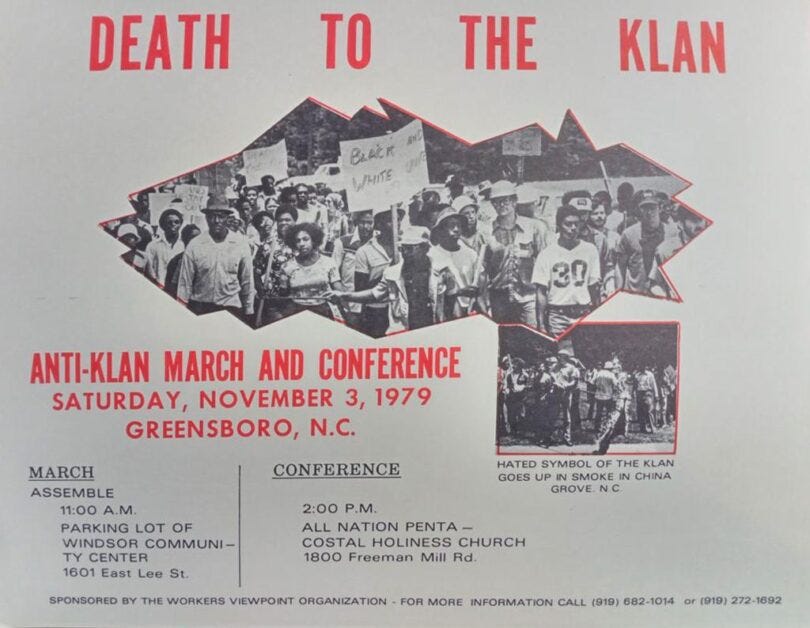
Flyer for the anti-Klan Rally in Greensboro, NC that ended in a massacre
My understanding of America has always been shaped by an event that changed my family’s life: on November 3, 1979, the Ku Klux Klan and American Nazis murdered five of my parents’ friends.
They killed these five young organizers for bringing workers together across racial lines, for daring to challenge the KKK directly in a rally. The murders were caught on video in broad daylight, but the killers were all acquitted in two criminal trials. The Greensboro Police had known the Klan’s intentions, and left the scene just before they began shooting.
The problem was that some of those organizers were communists. For many in North Carolina, communists were as bad as Klansmen. My parents, uncle, and aunt spent the next decade seeking justice for the families of the Five, trying to change the narrative of what happened.
Last week, just before America’s 250th birthday, I went with my family to see a musical about this story: The Potluck by César James Alvarez. Like me, Alvarez is of the second generation, born to friends of the Greensboro Five. César’s names come from two killed that day: César Cauce and James Waller.
Reader, believe me when I say this musical about a terrible murder had me laughing nonstop for the first ten minutes. The musical opens with the character “César” wearing hot pink shoes and sighing over a MacBook as they grapple with the weight of honoring these five martyrs.
Instead of writing, they procrastinate by singing about all the Nazis in musicals, and calling their parents, who are more interested in talking about weekend plans than Greensboro. The humor offers an embrace: this show will be intense, but just like in life, there will be joy, too.
César finds, in the course of the musical, that the best way—the only way—to honor the Five is to reconcile their own truths: coming into their queerness, facing their fear of failure, finding a way to make art under capitalism. It is César’s expansive imagination, their exploration of faith, that opens a way. César builds an altar to the five, a portal that invites the five to come forth and speak for themselves.
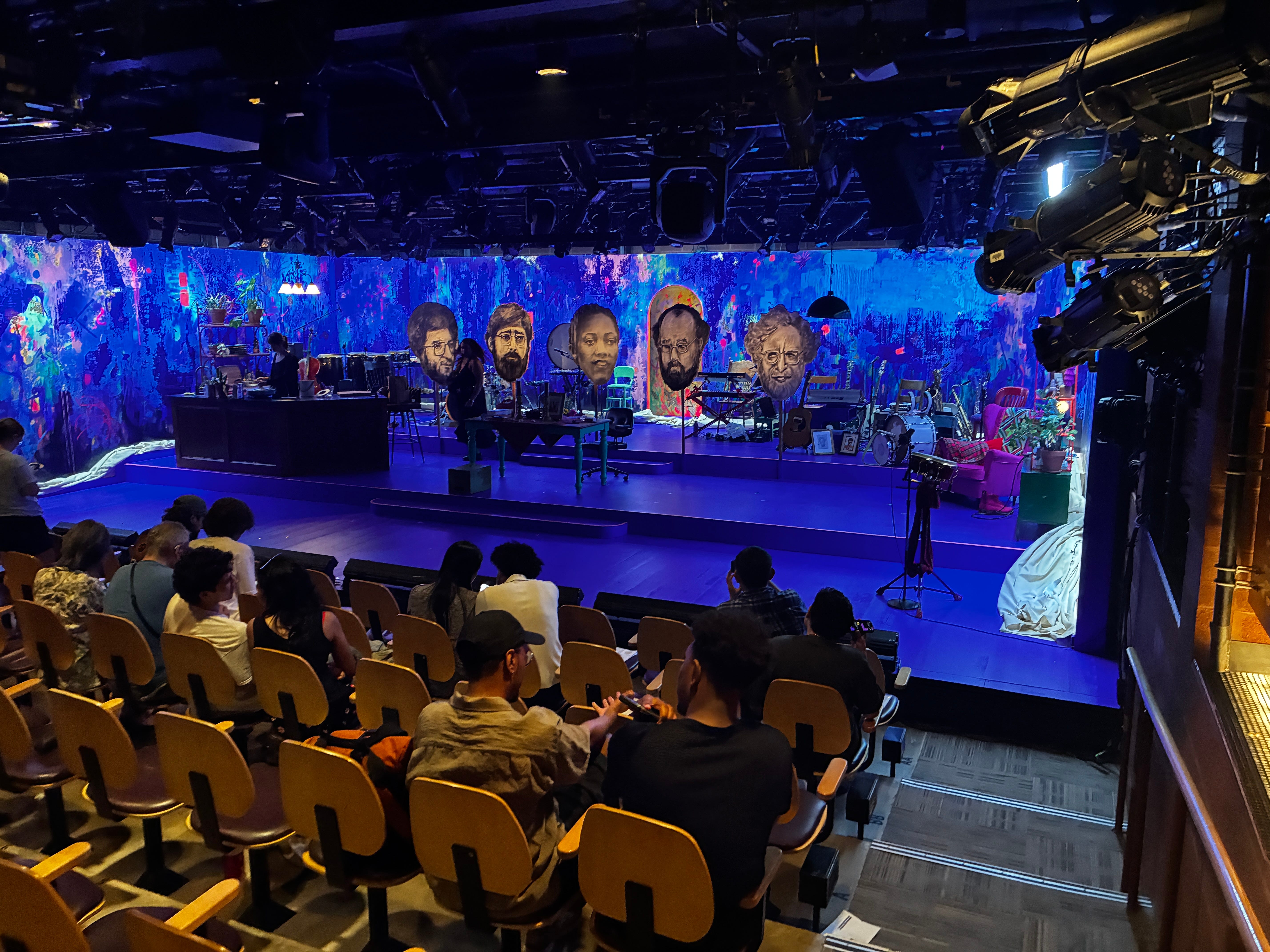
The Potluck at intermission at the Soho Rep. and INTAR
For many years after I learned about the Greensboro Massacre, I believed that America was a corrupt nation that needed a revolution. Any country that allowed such violence was broken, and any effort that didn’t overturn it was a waste of time.
Ironically, this simple narrative prevented me from facing that past. I couldn’t move forward if all I felt was rage, if all I wanted was retribution.
Like César, I first had to honor my own complicated feelings about the Massacre. And to do this, I needed two things that our parents’ generation had little of: art and faith—in my case, writing and Buddhism.
Writing allowed me to place the mess of personal and social history into a narrative. I saw how revolutionary theory offered my parents’ generation the sense that they could remake the world. I could reach through the door of literature and feel the thrill of those radical days. But I also saw how my own political anger was simply repeating the past, turning tragedy into politics, and skipping over grief.
For that, I needed Buddhism. Buddhism showed me that grief is not just a stage, or something that happens automatically with time—it is a constant practice, a way of integrating loss. Sitting meditation is, among other things, a ritual of grief: I remain still and let go of everything else I could be doing. Many of our chants invite in our ancestors, allowing us to hold them close. And, just like in The Potluck, we are always creating altars, marking our immaterial memories and connections with physical objects.
With this, I could hold a more complex truth of the Massacre.
I could hold the fact that the KKK and Nazis murdered five of my parents’ friends with little consequence, while knowing that a beautiful community of organizers, artists, and friends came out of this tragedy.
I could remain angry at America’s hypocrisy and violence while appreciating the freedom and possibility I’ve received from it.
I could accept that five lives were cut short in 1979 and nothing would bring them back, and that the meaning of those five lives was still being determined, a lesson conceived by the living.
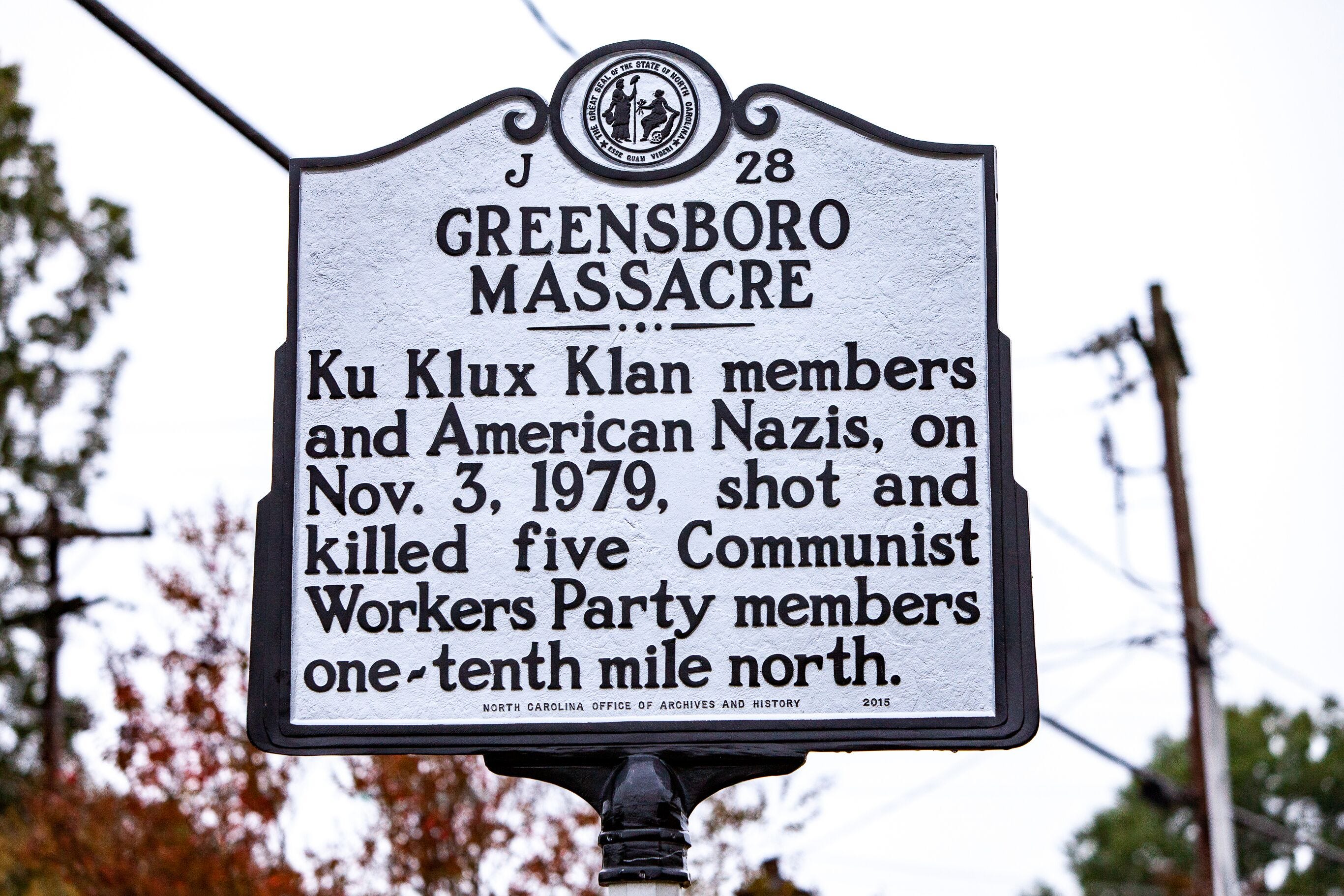
A hard-won historic marker of the Greensboro Massacre
Without saying too much, a key scene in The Potluck involves a meal with the Five. It is one of several moments where I cried.
As I watched that meal on stage, I thought of how Buddhists feed the ‘hungry ghosts,’ the spirits whose lives are unresolved, who are forever searching for fulfillment. The hungry ghosts might be our ancestors, they might be the forgotten of our land and society, or they might be a metaphor for the part inside each of us that goes lacking.
The meaning of the Greensboro Massacre is far from settled. The meaning of America is far from settled. We make meaning when we become completely ourselves, when we use every reserve of art and joy to welcome our ghosts.
Updates and Recs
The Potluck runs until July 26 and it’s almost sold out—get tickets here.
I’m hosting a new, limited-series podcast with Axis Mundi Media on Buddhism, Asian America, and organizing—more details soon. Gratitude to the Luce Foundation for supporting it.
I just returned from the annual Garrison BIPOC Retreat, and it was life-changing. It was also the first retreat I did with my mom. One highlight: daily ‘deep relaxation’ in the chapel proving that rest is, indeed, sacred.
I plan to join parts of the Day of Remembering Our Interdependence in NYC on July 12, inspired by the recent cross-country Walk for Peace.
I finally made it to Tehching Hsieh: Lifeworks 1978–1999 at Dia Beacon. I’ve been thinking about Hsieh’s work for years, and I always find new revelations about ART TIME and LIFE TIME. I was quoted in a long profile of Hsieh that previewed the exhibition.
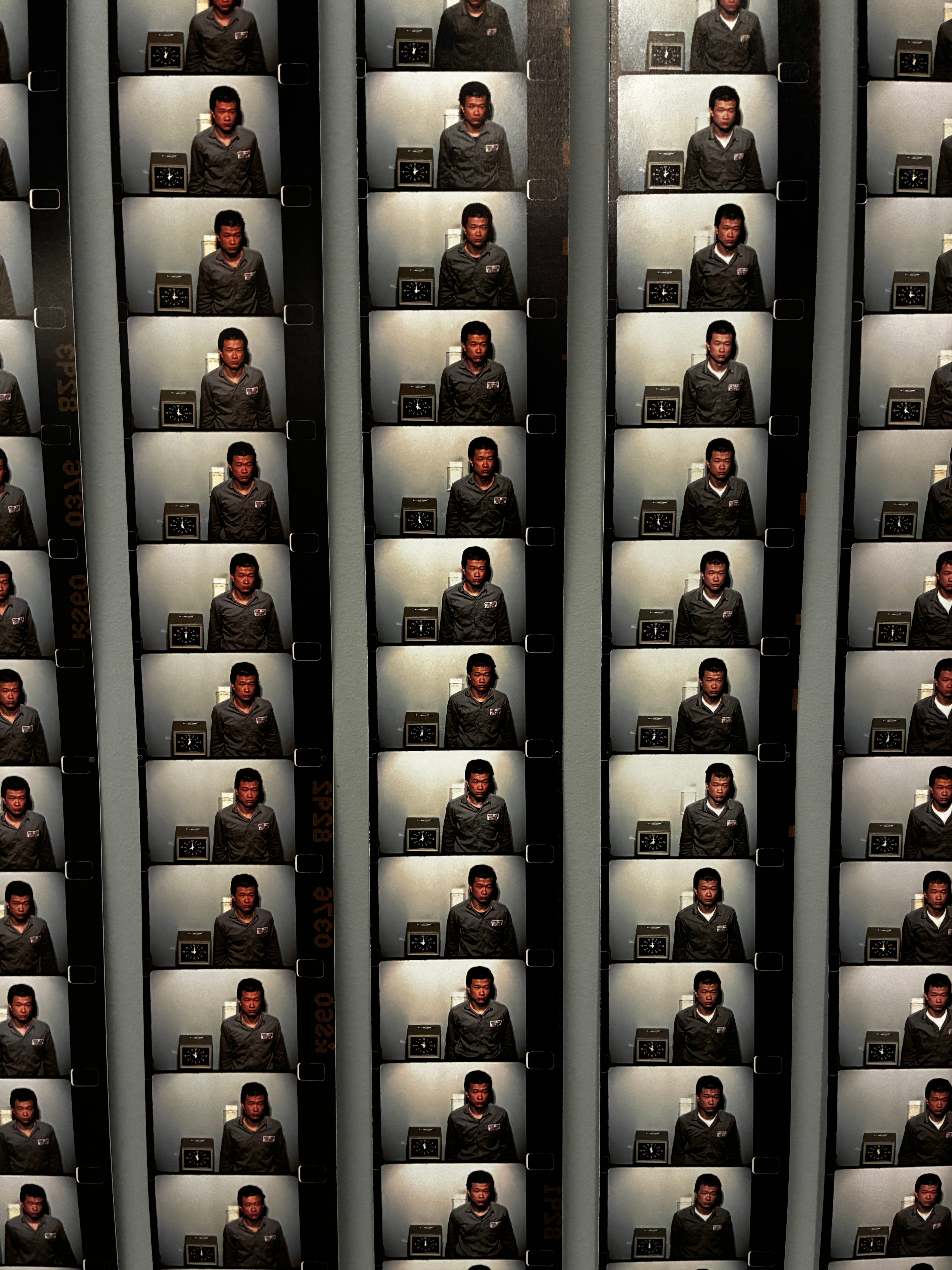
Documentation of a performance in which Hsieh punched a time clock every hour, on the hour, for an entire year
I’m glad you popped up in my feed.
Thank you for your audio- an insightful, poignant essay, beautifully read. Keep it up. I wish I could see the musical but I’m living in New Zealand now. I doubt it will make it here and it doesn’t sound like something Netflix will tackle. Are there any recordings, clips, trailers to be found?
Yes, we make meaning with our lives, our writing, our creativity and artistic expression and appreciation, and with love, joy, faith, and connecting with each other.